

Dental Bridges
Henderson, NV

Fill The Missing Teeth With Dental Bridges
Green Valley Smile Care is a reliable dental clinic that helps you and your loved ones achieve a beautiful smile and maintain optimal oral health. Individuals who experience permanent tooth loss due to periodontal disease, extensive decay, trauma, or side effects of medical treatment can trust us for comprehensive dental care. Our clinic offers high-quality dental bridges in Henderson to help patients regain functional, attractive, and complete smiles.
How Can Missing Teeth Impact Your Smile’s Function And Health?
The impact of tooth loss goes beyond creating embarrassing gaps in your smile. If the sockets remain without replacements, they can affect your smile’s health and function in the following manners:
- Impair your ability to smile, speak, and chew with confidence and ease.
- Make the neighboring teeth shift gradually and occupy the empty spaces, impacting the alignment of your smile and bite.
- Move teeth in the opposite arch out of place since they don’t have the counterpart needed for proper alignment, causing further bite problems.
- Shifting teeth increases the risks of gum disease and cavities, leading to issues with the distribution of chewing and biting forces. Keeping your mouth clean also becomes challenging after misalignments due to missing teeth.
Reshaping Smiles with Dental Bridges
A missing tooth from a natural set of your mouth creates an impact both on your dental health and overall well-being. In modern times, dentistry has become advanced in materials, technology, and treatment methods. It's become easier now than before to easily replace missing teeth and get aesthetically pleasing and long-lasting results.
Smiles are different and every patient has unique needs and expectations of their smile makeover. According to the needs of the patients, building a complete and beautiful smile may involve application of partial or full dentures, fixed dental bridges, or dental implants.
Being a skilled and experienced dental care provider in Henderson, Green Valley Smile Care offers expert guidance in choosing the right and suitable treatment option. Whatever tooth replacement method you select, you can have the confidence that your smile will look good and feel great.
About dental bridges
A dental bridge can replace a missing tooth, offering a stable, permanent, and effective solution. Unlike removable partial dentures that clasp onto the remaining teeth, a dental bridge relies on the support of crowns attached to teeth adjacent to the edentulous area (space without teeth) or strategically placed implants. Bridges restore the appearance, functionality, and feel of a natural smile and prevent the teeth from moving. They safeguard the patient's bite alignment.
The history of using fixed dental bridges to replace missing teeth dates back thousands of years, which means it's not entirely a modern concept. Ancient civilizations used remarkable resources, including ivory, bones, gold, and human and animal teeth, to fill dental gaps. All these materials offered durable tooth replacement solutions.
Fortunately, dental technology and materials have evolved over the years. Today, bridges are fabricated from the highest-quality materials, including porcelain, porcelain fused to metal, and engineered ceramic products like zirconia. They are more durable and stronger materials for dental restorations, which also enhance the inherent beauty and aesthetic appeal of a grin.
Common types
A dental bridge is proven effective in replacing one or more missing teeth. The type usually depends on the number of lost teeth, the health of surrounding ones, and other factors.
The four main categories of dental bridges comprise implant-supported, traditional fixed, Maryland, and cantilever. Patients are most frequently recommended either traditional or implant-supported bridges, depending on their unique needs.
Traditional fixed bridge
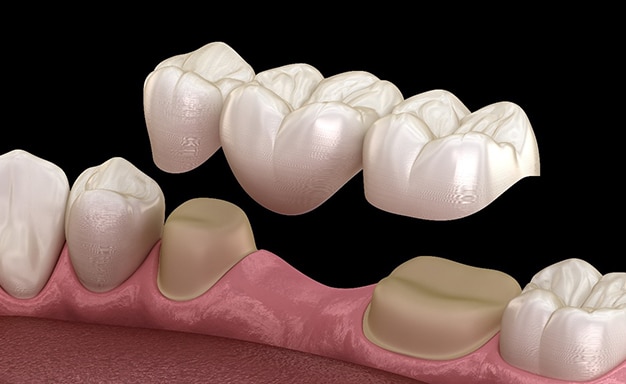
Typically, teeth on either side of the edentulous space need appropriate preparation and crowning to fit a traditional fixed bridge. After crowning, these teeth support the artificial ones, also known as “pontics”, to fill the gap efficiently. A traditional bridge is a dental restoration that uses the crowns on adjacent teeth to support one or multiple pontics. This type of bridge offers stability and strength, enhancing your smile’s aesthetics and function.
Although related and similar to a traditional fixed bridge, a cantilever fixed bridge differs in one significant way. It takes attaching only one side of the pontic to support the crown.
Implant-Supported Bridges
As the most advanced method for replacing missing teeth, implants come the closest to replicating the look, feel, and function of a natural smile. This is why implant-supported bridges are frequently recommended to fill the gaps and complete your grin.
When you opt for an implant-supported bridge, it doesn’t involve crown preparation or any adjacent healthy teeth for replacement. Typically, dental implants provide all the necessary support for bridges. They function and appear like real tooth roots.
Alongside offering a self-supporting replacement option for missing teeth, implant-supported bridges restore a complete smile following the most versatile method. Strategically placed dental implants can support any number of replacement teeth up to an entire set of upper teeth.
Furthermore, since implants stimulate the surrounding jawbone like real roots, implant-supported bridges combat bone shrinkage that might occur after losing one tooth or multiple teeth. This specific characteristic helps dental fixtures preserve natural facial contours.
Green Valley Smile Care’s mission is to provide every patient the opportunity to maintain good oral health and a beautiful smile. We provide personalized care and offer the most advanced dental bridges to transform incomplete smiles into ones that look great, function well, and inspire confidence.
Before a bridge gets fabricated
Several factors determine the success of tooth replacement with dental bridges. The top aspects include the patient’s budget, smile goals, lifestyle, oral health, and general well-being. Through a dental examination at our office, we evaluate your candidacy for a traditional fixed bridge, removable denture, or implant-supported bridge. We appreciate valuable feedback from our patients on our dental care and strive to meet their expectations.
It is crucial that you have a healthy mouth and there’s no periodontal disease before dental bridge fabrication and placement. If you have gum disease, it will need to be treated in advance of fabricating your bridge.
The crowned teeth for traditional fixed bridges must have adequate strength and surrounding bone for optimal support. At times, before fabricating a traditional or implant-supported bridge, you may need bone grafting to maintain adequate bone density and serve as a strong base.
Green Valley Smile Care prioritizes patient comfort and delivers the highest level of care. Our goals are to create healthy and beautiful smiles and make every experience a positive one.
What to expect when getting a traditional bridge
When it comes to the fabrication of fixed dental bridges, it may take several visits to our dentist. This procedure involves taking impressions, preparing supporting teeth, placing temporary bridges, and fitting and securing the permanent restoration.
A thorough diagnostic workup is the initial step in customizing a suitable treatment plan. For patients receiving a traditional fixed bridge, the next step is preparing the supporting or abutment teeth for full-coverage crowns. Depending on the number of teeth involved and other factors, an impression of the permanent bridge can be taken on this visit or the next one. Either way, a temporary bridge or crown will be placed to cover and protect the prepared tooth.
It is very common to experience mild gum soreness and sensitivity during the teeth preparation phase. This discomfort usually subsides after a while. Until the placement of a permanent dental bridge or crown, you might continue to feel some residual sensitivity. The uneasiness dissolves after the completion of treatment.
You must remain extra cautious until the final placement of your crown or bridge. Permanent restorations are likely to last longer than temporary ones. If your temporary gets damaged or comes off, please hold on to it. Contact our dental office in Henderson, and we will set up an appointment to replace it. Do not attempt to do this on your own.
Our dentist thoroughly examines the fit, shade, occlusion, and contours to ensure your bridge properly affixes. We perform the permanent restoration after the detailed assessment. Your bite may feel slightly different, or you may experience certain pressure when wearing a temporary bridge. This will subside when the new restoration maintains adequate contact with the neighboring teeth. If the bite still feels slightly off after a couple of days or any discomfort persists, get in touch with our office. You might still need our dentist for minor adjustments.
What to expect when getting an implant-supported bridge
We place dental implants through a minor surgical procedure with an outpatient approach. However, the exact extent of the procedure depends upon the type and number of implants and whether or not additional procedures are required to prepare the supporting bone.
Our office will keep you updated at every stage of dental care. Several comprehensive diagnostic records help us ensure the precise placement of implants for the success of implant-supported bridges. The records may include 3D images of your jaws and surrounding areas, which help us plan your treatment.
Our focus is always on elevating patient comfort and care. We go above and beyond to make you feel stress-free and comfortable during every visit to our dental practice. To ensure success with implant placement, we’ll thoroughly discuss pre-op care, dental sedation, anesthesia, and post-operative guidelines.
After a successful insertion into the jawbone, the implants in your dental bridge may take several months to fuse with the neighboring bone. There are situations where we may install a same-day temporary bridge to help you achieve an aesthetically pleasing smile. Once the healing and osseointegration with the surrounding bone is completed, we usually place the permanent bridge.